What is IIS sustainability and why does it matter?
ISS play a critical role in supporting immunization program operations, clinical decision making, population health monitoring, and emergency response efforts.3
IIS sustainability refers to the ability of a jurisdiction to maintain, operate, and continuously improve its IIS over time despite changing funding environments and evolving public health needs. Sustainable IIS are able to consistently deliver reliable, high-quality functionality and data while adapting to new demands and situations.
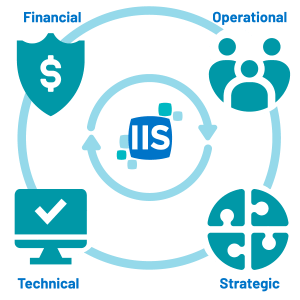
In practice, IIS sustainability includes:
Financial sustainability: Stable and diversified funding that supports core operations, maintenance, modernization, and workforce needs.
Operational sustainability: Efficient workflows, strong governance, and a skilled workforce capable of maintaining and advancing the IIS.
Technical sustainability: Modern, interoperable, secure, and scalable infrastructure that can integrate with evolving technologies and data standards.
Strategic sustainability: Alignment with immunization program priorities and partnerships that maximize the value of the IIS to partners and the public.
IIS sustainability is important because when IIS are sustainable and well-supported, they help to:
Ensure timely, accurate immunization data is available for clinicians, schools, public health programs, policymakers, and the public
Support vaccination coverage assessment and monitoring, including CDC’s Immunization Quality Improvement for Providers (IQIP) program
Identify populations that may be at risk for vaccine-preventable disease
Identify geographic areas with low vaccination coverage
Inform program interventions to increase vaccination rates
Enable rapid response to outbreaks and other public health emergencies
Enable Vaccines for Children (VFC) program providers to order and manage publicly purchased vaccines
Facilitate the operation of immunization program components, including surveillance and epidemiology, case management of vaccine-preventable diseases, prevention of perinatal hepatitis B transmission, and compliance with vaccination requirements in childcare, school, and college
Reduce administrative burden for providers and health systems
Unstable funding or inefficient operations can lead to system degradation, delayed modernization, workforce strain, and reduced data quality. When these challenges occur, IIS may struggle to provide efficient support for business functions and the collection of timely, high quality, and complete immunization data. This may result in limiting their ability to monitor coverage, identify at-risk populations, and inform public health interventions. Gaps in system performance can hinder outbreak response and disrupt vaccine ordering, management and other business processes for VFC providers and public health staff. These challenges can also increase administrative burden for providers, public health staff and other partners relying on the IIS to help achieve immunization goals. All of these effects could ultimately weaken the impact of immunization programs and broader public health efforts.