
| Module 1 | Introduction |
Unit 1
| ||||
|---|---|---|---|---|---|---|
| Module 2 | Getting Started |
Unit 1
| ||||
| Module 3 | Audiences/Roles |
Unit 1
|
Unit 2
|
Unit 3
|
Unit 4
|
Unit 5
|
| Module 4 | People & Processes |
Unit 1
|
Unit 2
|
Unit 3
|
Unit 4
| |
| Module 5 | Standards |
Unit 1
|
Unit 2
| |||
| Module 6 | Tools |
Unit 1
|
Unit 2
|
Unit 3
|
Unit 4
|
Unit 5
|
| Module 7 | Implementations |
Unit 1
| ||||
| Module 8 | Resources |
Unit 1
|
Unit 2
| |||
| Module 9 | Appendices |
Unit 1
|
What are CODI data models?
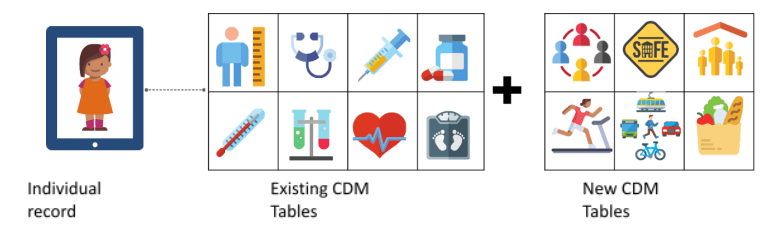
The CODI data models are an extension of the National Patient-Centered Clinical Research Network’s (PCORnet) Common Data Model (CDM), a standard data model representing anonymized patient-level data for research. CODI augments the PCORnet CDM with a representation of chronic disease prevention programs and individual-level program participation data. Researchers can use CODI to access anonymized longitudinal record data for individuals that includes both clinical history and local public health program data.4 The Implementation Guide provides details on both data models. CODI brings together data stored across different sectors and organizations to create individual-level, linked longitudinal records that include social determinants of health (SDOH), clinical and community interventions, and health outcomes. CODI also creates longitudinal household records, linking individual longitudinal records within the same household.
Broader access to standardized data
Social determinants of health
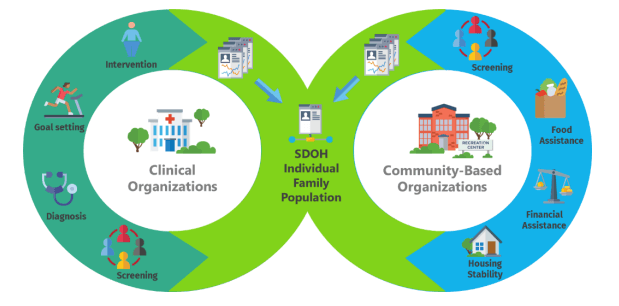
The CODI data models capture and integrate SDOH data from clinical and community-based organizations. Clinical organizations increasingly use electronic health records (EHRs) to screen, track, and evaluate individual SDOH. Community-based organizations screen and provide social services to address SDOH. Separately these data streams provide an inconsistent view of an individual’s social conditions. When linked across settings, they provide a more complete picture of an individual’s social conditions. CODI aggregates these data at the individual, family, and population levels.
RECORD LINKAGE DATA MODEL (RLDM)
Defines the data tables and data elements needed to perform the Privacy Preserving Record Linkage (PPRL) process. The model includes two tables from PCORnet CDM designed to contain unencrypted personal identifiable information (PII). These two tables must be implemented by a Data Owner or partner in a secure repository.
RESEARCH DATA MODEL (RDM)
Provides the data tables and data elements needed to answer selected chronic disease research and program evaluation questions.
User videos